

Problem Based Learning
A learning method fully centered on the employee.
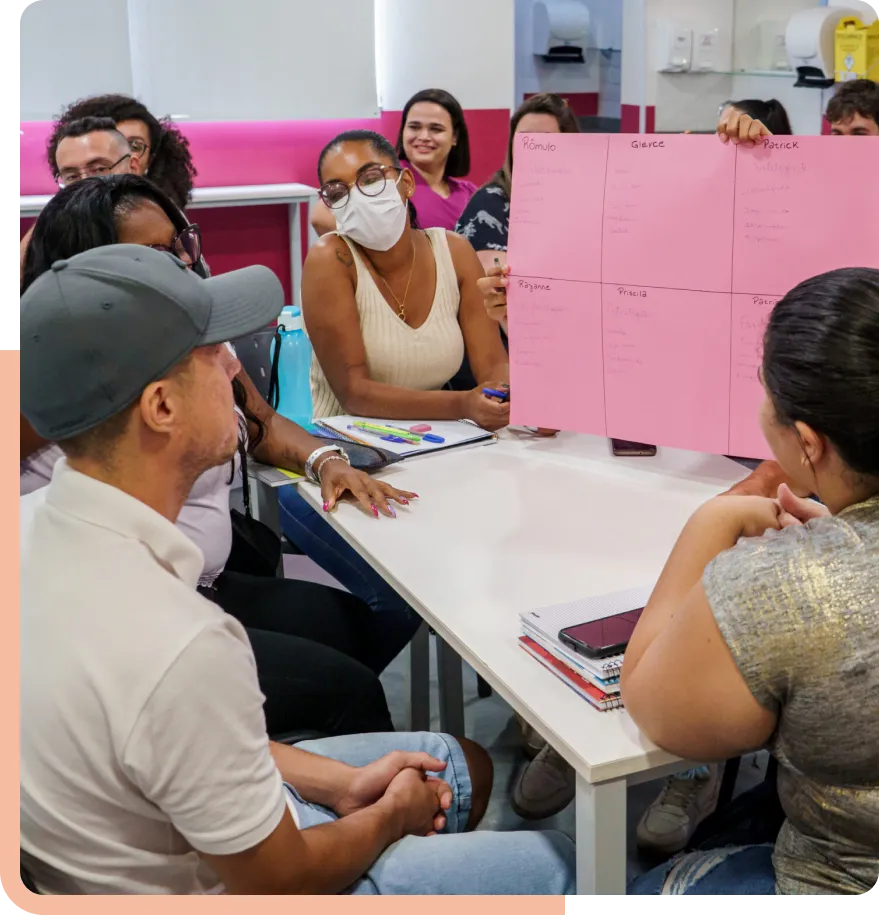
Do you know what PBL is? It is a learning method fully centered on the employee. Specialists solve practical problems under the guidance of a supervisor to stimulate critical thinking. In this way, employees become problem solvers and are better able to handle unexpected everyday situations.
But it is not just about trying to solve problems. PBL represents learning opportunities because it is a self-directed instructional technique. Problem-Based Learning (PBL) is a teaching method that has been attracting the attention of companies and educational institutions.
This approach was first adopted by McMaster University in Canada and Maastricht University in the Netherlands around 1969. In Brazil, it arrived through the Faculdade de Medicina de Marília in São Paulo and the Faculdade Estadual de Londrina in Paraná.
In PBL, the audience is no longer just the recipient of the trainer's message. Here, learning is active, and employees acquire knowledge and skills while solving current problems through self-study. In this way, the approach breaks with traditional teaching models, offering advantages such as professionals' ability to solve problems in unexpected situations, the development of critical and creative thinking, and a sense of responsibility for continuous learning and improvement.
However, to apply this approach within a company, professionals must understand that this type of learning depends entirely on them. Mentors only guide the team toward the learning objectives. Managers can help motivate employees for this type of training. Therefore, problem-based learning is ideal for active, self-taught professionals who learn best through reading and discussion and who know how to set flexible learning objectives.
How Does Problem Based Learning Work?
In a PBL-based learning process, content is presented in the form of problems to be solved.
During this process, professionals do not attend classes or lectures. Instead, they receive questions and then look for the information and resources they need to get them right.
Because the problem is complex and requires a lot of information, it is ideal for group projects. Professionals are usually divided into groups of up to 12 people.
The group then brainstorms, formulates hypotheses, and looks for additional information that can address these challenges. The whole process takes about a week on average.
There are several sessions, ranging from one to two hours, in which each stage is presented. Problem-based learning can be complemented by workshops and lectures from specialists.
Groups can also share experiences with their peers.